A few of the people I train have fibromyalgia. Enough of them that I get asked about it fairly often, usually some version of the same question: is exercise going to help, or is it going to make me worse?
The honest answer is that it depends almost entirely on how it’s done. The same session that leaves one person feeling better can put another in bed for two days, and the difference is nearly always pace rather than exercise choice. So here’s how I actually run it.
Worth saying up front: I’m a personal trainer, not a doctor. Fibromyalgia is managed by your GP or whoever’s looking after you, and nothing here replaces that. Have a word with them before you start something new. I’m telling you how I coach it, that’s all.

Most of this happens on a living room floor. No gym needed for any of it.
The thing that catches everyone out
Most people judge a workout by how they felt during it. With fibromyalgia that’s the wrong measurement, because a session can feel absolutely fine and the bill turns up a day and a half later.
So I judge sessions on how someone is two days afterwards. Same or better, that was the right amount. Wiped out or sorer than usual, it was too much — even if it felt easy at the time, and even if it was less than they used to manage.
That one change makes most of the rest of this obvious.
How long the sessions are
Shorter than you’d think. I start people at about ten minutes including the warm-up, two or three times a week, with a day off in between. Some start at five.
Ten minutes sounds like nothing. It isn’t, when the alternative is a half-hour session that costs you the rest of the week. Small and repeatable beats big and occasional here more than anywhere else I can think of.
How long the rest is
Longer than I’d give anybody else. Roughly thirty seconds of work to a minute or more of rest, and I’m relaxed about that minute stretching if it needs to.
The rest isn’t wasted time. It’s the thing that lets you finish the session in the same state you started it.
How hard it should feel
If you can hold a conversation the whole way through, that’s about right. If you can’t get a sentence out, that’s past where we want to be, and you’ll hear about it on Thursday.
Nothing goes near your limit. No carrying on until you can’t do another one. There’s no version of this where pushing to the edge pays off.
When to add more
Later than feels right. I hold the same thing for two or three weeks before changing anything, and when it does change I add one thing — either a couple of minutes, or one more set. Never both.
Then I wait and see what the two-day check says. If it’s fine, that’s the new normal. If it’s not, back a step and sit there a while longer. Going back a step isn’t losing ground, it’s information.
Good weeks are the trap. Feeling decent on a Tuesday and doing double is the most common way this comes apart. The plan doesn’t change on good days.
The moves I use
Nothing exotic. Things you can do on the floor or from a chair, that don’t load one bit of you heavily, and that scale down without any thought.
Legs and hips: glute bridges, step-ups onto something low, sitting down and standing back up out of a chair, calf raises with a hand on the worktop, side-lying leg lifts.
Middle: dead bugs, bird dogs, tabletop holds for a few seconds at a time.
Upper body: press-ups on your knees or against a wall, YTWs, shoulder rotations, overhead reaches, shrugs.
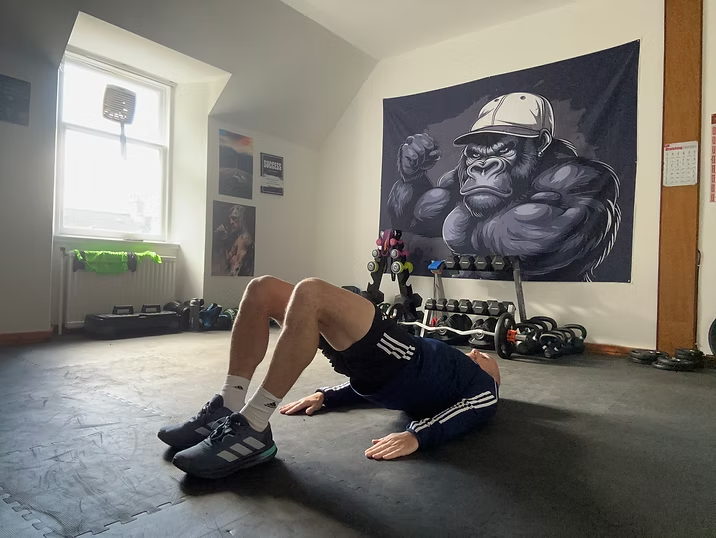
The glute bridge. Floor, no kit, easy to make smaller on a rough day.
And walking. Flat, your own pace, timed rather than measured in distance — ten minutes out the door counts as the session.
Warm water is worth a mention if there’s a pool near you. Plenty of people who struggle on land move far more comfortably in a warm pool, and it tends to be the kindest way back into moving at all.
What I go easy on
Long holds. A minute-long plank is a lot of sustained tension, and it’s usually the thing that shows up two days later. Short holds, repeated, do the same job more kindly.
The lowering half of a movement — the slow part on the way down. That’s the bit most associated with next-day soreness, so I keep it controlled rather than drawn out.
Jumping, running, anything with impact, at the start. That can come later if it comes at all, and plenty of people do perfectly well without it ever turning up.
Flare days
The plan on a bad day isn’t nothing. It’s less.
Two or three minutes of gentle movement — shoulder rolls, ankle circles, a slow walk to the end of the road — usually leaves people better than lying still, and it keeps the habit intact without asking anything of you.
And there’s nothing to make up afterwards. You pick up where you left off, not a step further on to compensate.
One important exception
Some people have fibromyalgia and ME, or chronic fatigue, at the same time. That matters here, because the guidance for ME went the other way in 2021 — NICE stopped recommending programmes built on fixed, step-by-step increases in exercise, because for some people that made things worse rather than better.
So if that’s you, the gradual build I’ve described isn’t automatically the right shape. It becomes about staying inside what you’ve got on a given day rather than adding to it on a schedule. That’s a conversation for you and your GP, and it’s one I’d want to know about before we planned anything.
The practical bits that make a difference
Time of day. A lot of people are stiffest first thing, which makes early sessions the hardest ones for no good reason. Later in the day often works better.
A warm room. Cold makes everything harder and it’s the easiest thing on this list to fix.
A longer warm-up than normal. About five minutes of easy movement before anything else — which on a ten-minute session is half of it. That’s fine.
Sleep. It’s the biggest single thing moving symptoms around week to week, and it means the same session genuinely is harder some weeks than others. That’s not you being inconsistent. Plan for it.
Where the app comes into it
I built Core Buddy so the workout decides itself. You say how long you’ve got and what you’ve got to hand, and it builds the session and times it. For this in particular the short sessions and the video on every move are the useful part — you’re not stood there working out what to do, and you’re not guessing at the timing.
What it doesn’t do is know about your condition. It can’t tell a good week from a flare. So if you’re using it with fibromyalgia: pick the shortest option, use the easier versions where they exist, and let the two-day check decide whether next week looks the same or smaller.
If you’re starting this week
Ten minutes, twice, with a couple of days between them. The same ten minutes the following week. Then have a look at how you’ve been.
That’s the whole plan for the first month. It looks far too small to do anything, which is exactly why it tends to work.
One last thing, plainly: Core Buddy is not a medical device and does not diagnose, treat or prevent any condition. Nothing here is medical advice, and it isn’t a substitute for the care of your GP or specialist. If something new or unusual turns up while you’re training, stop and get it looked at.
Want the sessions picked and timed for you?
Core Buddy builds the workout, times every move, and has a video on all of them. Start on the ten-minute option and go from there. Free to download, and the 30-day free trial covers the lot.